When Do You Need a Plumbing Permit? A Homeowner's Guide
Plumbing permits cost $50-$400 and are required for most new installations. Skipping them can affect your home sale and insurance. Here's when you need one.
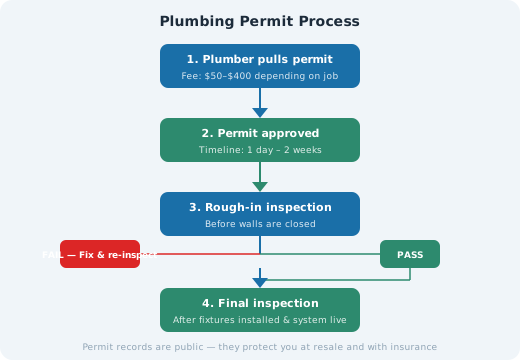
Quick Answer
Permits are required for new installations, modifications to supply or drain lines, water heater replacements, and sewer work in most jurisdictions. Simple repairs and in-kind fixture swaps typically don't require permits. When in doubt, call your local building department. It's free to ask.
Permit requirements for plumbing vary by state, county, and municipality. What requires a permit in one city might not in the next. But the consequences of skipping a required permit are consistent: unpermitted work can trigger issues during home sales, complicate insurance claims, and require expensive retroactive correction.
Why Permits Exist
A plumbing permit triggers an inspection by a code official. Most jurisdictions base their rules on model codes published by the International Code Council or the IAPMO Uniform Plumbing Code. The inspector verifies that:
- Pipe materials comply with local code (not all materials are permitted everywhere)
- Drain lines have proper slope and venting
- Connections to the municipal water and sewer systems meet standards
- The work was done by a licensed contractor where required
This process protects you. A plumber who knows their work will be inspected does it right. Inspections catch errors that can cause water damage, sewer gas infiltration, or structural issues down the road.
What Typically Requires a Permit
These categories almost universally require a permit:
New construction: Any new plumbing installation in new construction or an addition.
Repiping: Replacing the supply lines in an existing home. Even a partial repipe (one floor or one bathroom) typically requires a permit.
New bathroom or kitchen installation: Adding new drain, supply, or vent lines.
Water heater replacement: Most municipalities require permits for water heater installation, even for a like-for-like swap.
Sewer line repair or replacement: Any work on the lateral from your home to the municipal main requires a permit, and in many cases, the municipality must be notified for the final connection.
Gas line work: All gas piping work requires a permit in virtually all jurisdictions, without exception.
Moving or adding any fixture: Adding a bathroom sink, moving a toilet, adding an outdoor shower: anything that modifies the existing pipe layout.
What Typically Doesn't Require a Permit
These repairs are generally permit-exempt:
- Replacing a faucet in the same location
- Replacing a toilet (same drain location)
- Fixing a clogged drain
- Replacing a showerhead
- Repairing or replacing a garbage disposal (like-for-like)
- Replacing supply lines under a sink
- Fixing a running toilet (tank internals only)
The pattern: repairs and in-kind replacements (same location, same fixture type) are generally exempt. New installations and anything that modifies the pipe layout requires a permit.
Permit Costs
Plumbing permit fees vary widely:
- Simple installations: $50-$150
- Water heater replacement: $75-$200
- Bathroom rough-in: $100-$300
- Whole-house repipe: $150-$400
- Major renovation: $200-$600+
In some high-cost jurisdictions (New York City, San Francisco), permit fees can run higher. Your licensed plumber handles the permit application and knows the local fee schedule.
The Inspection Process
After pulling a permit, work must be inspected at specific milestones:
Rough-in inspection: Before walls are closed. The inspector verifies pipe layout, slope, venting, and materials while everything is visible.
Final inspection: After fixtures are installed and the system is operational. The inspector tests for proper water flow, drain function, and pressure.
In some jurisdictions, there may also be a slab inspection (before concrete is poured) if the work involves below-slab drainage.
Your plumber schedules these inspections. Some municipalities now offer same-day or next-day inspection appointments; others book 1-2 weeks out. Factor this into your project timeline.
What Happens Without a Permit
Home sale complications. Home inspectors identify unpermitted work. Once identified, it must be disclosed to buyers. Buyers can require it be retroactively permitted or request a price reduction. Retroactive permits sometimes require opening walls that have already been finished.
Insurance issues. If unpermitted work causes water damage, your insurer may deny the claim. Standard policies exclude coverage for damage caused by work that violated local code.
Legal liability. Selling a home with undisclosed unpermitted work can expose you to litigation if the buyer later discovers the issue and can demonstrate harm.
Code enforcement. In some jurisdictions, code officers can require unpermitted work to be removed and redone at the homeowner's expense if discovered during a neighboring inspection or complaint.
How to Check Permit Requirements
The easiest approach: call your local building department and describe the work. They'll tell you whether a permit is required, how much it costs, and what inspections are required. Most departments can answer this question over the phone in five minutes.
If you're hiring a licensed plumber, they should handle permits automatically for work that requires them. The Plumbing-Heating-Cooling Contractors Association publishes member guidelines that treat permit compliance as a baseline professional standard. If a contractor tells you "we don't bother with permits for this type of job," that's a red flag.
Regional Cost Variations
Permit fees and processing times swing hard by city. In Houston and Phoenix, a water heater permit runs $75-$125 and issues the same day online. Smaller Texas and Arizona cities often waive fees entirely for simple like-for-like replacements. Building departments in these markets prioritize fast turnaround to keep construction moving.
East Coast cities charge more and move slower. New York City plumbing permits start at $165 and can push past $500 for bathroom rough-ins, with 2-3 week processing on anything requiring plan review. Boston, Philadelphia, and Washington D.C. sit in similar territory, with $200-$400 typical permit fees and mandatory inspections that book 1-2 weeks out.
California is its own category. San Francisco charges $250-$600 for standard residential plumbing permits and requires a licensed contractor on most work. Los Angeles runs $150-$400 but adds seismic anchoring requirements for water heaters that bump total project costs. Chicago and Seattle fall between, at $125-$300 for typical residential permits with 3-7 day processing. Rural counties anywhere in the country tend to run cheapest ($40-$125) but may have only one inspector covering a large area, which stretches scheduling.
Frequently Asked Questions
What happens if I do plumbing work without a permit?
Small repairs rarely get flagged. But any work that should have been permitted becomes a problem at sale time. Home inspectors spot unpermitted water heaters, new bathrooms, and repipes fast. You'll either disclose it (losing $2,000-$15,000 off the offer), retroactively permit it (opening walls can run $1,500-$5,000), or face legal liability if you hide it.
Who pulls the plumbing permit: me or the contractor?
A licensed plumber should pull the permit under their license. That puts them on the hook for code compliance and inspection pass. If a contractor asks you to pull the permit as the homeowner, that's a warning sign, as it shifts liability to you and often means they're unlicensed or trying to dodge accountability.
How long does it take to get a plumbing permit?
Same-day to 3 weeks depending on the city. Simple permits (water heater, fixture replacement) issue online in minutes in most markets. Bathroom rough-ins and repipes need plan review, which takes 1-3 weeks. New construction or additions can run 4-8 weeks in busy metros. Budget accordingly.
Can inspectors make me tear down unpermitted work?
Yes, in most jurisdictions. If code enforcement discovers unpermitted work that violates current code, they can order removal and correction at your expense. A hidden unpermitted drain line with wrong slope could mean opening finished walls, ripping out tile, and rebuilding. That can easily run $3,000-$10,000 on a small bathroom.
Are plumbing permits worth it for small jobs?
For true small jobs (replacing a faucet, swapping a toilet, fixing a leak), no permit is needed and there's nothing to weigh. For anything in the gray zone like a water heater swap? Yes, always. The $100-$200 permit fee is trivial against a denied insurance claim or a failed home sale.
Use our plumbing cost estimator to include permit costs in your project budget. Also read our guide on when to hire a professional plumber to understand which jobs require licensed contractors by law.
Ready to estimate your plumbing project?
Use the Free Estimator →