Repair or Replace? How to Decide on Plumbing Fixtures
Replacing a fixture often costs less long-term than repeated repairs. Here's how to decide when repair makes sense and when replacement wins.
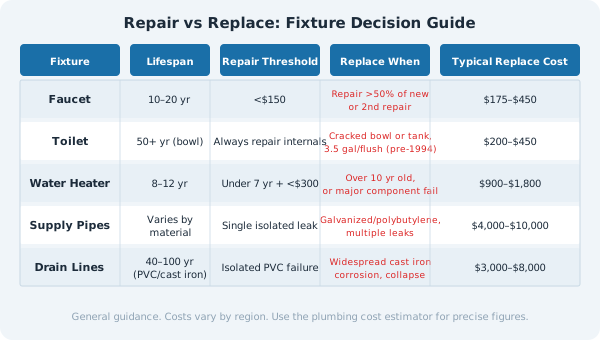
Quick Answer
Repair if the fixture is under 10 years old and the repair cost is under 50% of replacement. Replace if it's older, repeatedly failing, or if the repair cost is close to what a new unit would cost installed.
Every homeowner eventually faces this question: keep fixing it or buy new? For plumbing fixtures, the math isn't complicated, but it requires knowing what both options actually cost.
The 50% Rule
The simplest framework for repair-vs-replace decisions: if the repair costs more than 50% of what a new fixture would cost installed, replace it.
A new mid-range faucet costs $150-$350 installed. If the repair quote is $200 for a faucet that's already 12 years old, you're close to that threshold, and you're paying $200 to extend the life of a fixture that's past its useful lifespan. The new fixture comes with a warranty and another 10-15 years of reliable service.
Use this logic across fixture types and it holds up: it's not about the sticker price of the repair, it's about the value of what you're repairing relative to the replacement cost.
Decision Guide by Fixture Type
Faucets: Repair if under 10 years old and it's a quality brand (Moen, Delta, Kohler all offer lifetime warranties on many models, so the repair might be free for parts). Replace if the faucet is over 10 years old, cheap, or has been repaired twice already.
Toilets: Toilets themselves last 50+ years; the porcelain doesn't wear out. The internals (flapper, fill valve, flush handle) are $30-$80 in parts and worth replacing repeatedly. Replace the toilet only if it's cracked, running constantly despite multiple rebuilt attempts, or a very early low-flow model that uses 3.5+ gallons per flush (pre-1994).
Water heaters: Repair if under 7 years old and the repair is under $300. Replace if over 10 years old regardless of repair cost, or if you're dealing with a major component failure (heat exchanger, main gas valve). The Department of Energy notes most tank heaters hit peak efficiency loss after year 10, which tips the math toward replacement. See our water heater replacement cost guide for full cost details.
Supply pipes: Never repair galvanized steel or polybutylene supply pipes long-term. Patch-and-pray gets expensive fast. A full repipe addresses the root cause. Read about whole-house repipe costs to understand your options.
Drain lines: PVC drain lines can be patched if the failure is isolated. Cast-iron drain lines in older homes are worth evaluating: pinholes from corrosion can be repaired with rubber couplings, but widespread corrosion means replacement.
Calculate It First
Before deciding, estimate the cost of both options. Enter the repair as a simple repair job and note that cost. Then think through what a replacement would actually require. Sometimes it's simpler than you'd expect, especially for fixtures that are easily accessible.
For a like-for-like toilet swap in an average market, expect $200-$400 including the new unit. That's your comparison point when a repair quote comes in.
Hidden Costs of Repeated Repairs
One trap homeowners fall into: adding up individual repair invoices and thinking each one is "not that bad." But three $200 repairs on a 12-year-old fixture adds up to $600, enough to have replaced it twice with a better unit.
Track your repair history per fixture. If you've spent more than $300 on repairs to a single fixture in the last three years, replacement is almost certainly the better financial move.
The other hidden cost is your time. Plumbing repairs require scheduling, taking time off work, and dealing with water shutoffs. A new fixture often comes with years of trouble-free operation that's worth real money in avoided hassle.
When Repairs Always Win
A few scenarios where repair clearly beats replacement:
- Quality fixtures with manufacturer warranties: Moen's lifetime warranty covers cartridge replacements at no part cost. Delta's lifetime faucet warranty covers similar. These repairs are often free or under $50 for a service call. A replacement in the same scenario would cost $200-$400 installed.
- Recent installations under warranty: Any fixture or water heater under 5 years old with an active warranty should be repaired under warranty, not replaced out of pocket.
- Cosmetic issues only: A toilet with a hairline crack in the tank lid, a faucet with worn chrome finish, a slightly bent supply line: these are appearance issues, not function issues. Repair or live with them; they don't warrant replacement.
Regional Cost Variations
Where you live changes the math on repair-vs-replace. In high-cost labor markets, a $200 service call becomes a $350 service call, which pushes more jobs into "replace" territory. In low-cost markets, even older fixtures can be worth repairing because the labor is cheap.
San Francisco, Seattle, Boston: Plumber rates run $150-$200/hour. A minimum service call is often $250-$350 before parts. With those numbers, any repair on a fixture over 8 years old is usually worse value than replacement.
Dallas, Atlanta, Phoenix: Rates sit around $95-$130/hour. Basic repairs land at $150-$250, which makes repair the better choice more often. A $175 faucet rebuild on a quality Moen still beats a $300 replacement.
Rural Midwest and Southeast: $75-$110/hour is common. Independent plumbers can do a faucet cartridge swap for under $125. Stretching the life of older fixtures makes real sense at these rates.
New York City and Long Island: Service calls frequently start at $400 because of travel, parking, and union labor costs. Replacement wins by default on anything that isn't under a manufacturer warranty.
Frequently Asked Questions
How do I know when to repair vs replace a toilet?
Repair the toilet itself almost every time; the porcelain lasts 50+ years. Replace only if the bowl or tank is cracked, or if it's a pre-1994 model that uses 3.5+ gallons per flush (a new WaterSense-labeled toilet uses 1.28 gallons and pays for itself in 3-5 years on water bills). For internal parts like flappers and fill valves, $30-$80 in parts plus 30 minutes of labor is always worth it.
Is it cheaper to repair an old water heater or replace it?
If the tank is over 10 years old, replace it. A new 40-gallon tank runs $1,200-$1,800 installed, and a major repair (heating element, thermocouple, gas valve) often runs $300-$500, money wasted on a unit near end of life. Under 7 years old and still under warranty, repair every time.
How long should a kitchen faucet last?
A quality brand (Moen, Delta, Kohler) lasts 15-20 years. Cheap builder-grade faucets fail in 5-8 years. If you're past 12 years on a quality faucet and it's dripping again, the cartridge swap might be free under warranty, but the finish and O-rings throughout are also wearing out, so replacement is usually the smarter long-term play.
Do plumbers push replacement over repair?
Some do, some don't. Ask for both quotes in writing and compare. A plumber billing on flat rate often makes more on replacements, while an hourly plumber may prefer shorter repair jobs. Get a second opinion on any replacement quote over $1,500, and check that your plumber holds credentials through PHCC or equivalent local licensing.
What's the cheapest plumbing fixture that still lasts?
For faucets, Moen's builder line runs $80-$120 and comes with the same lifetime warranty as their premium models. For toilets, the Kohler Cimarron and American Standard Champion 4 sit around $250 and routinely last 20+ years. Skip the $40 big-box specials; they fail fast and the parts aren't available.
The Bottom Line
Check the age, check the warranty, get the repair quote, get the replacement quote. Run the 50% calculation. In most cases, the math makes the decision for you. Our plumbing cost estimator can help you understand what a new installation would actually cost in your area before you commit to a repair.
Ready to estimate your plumbing project?
Use the Free Estimator →